
-
The Struggles of Academic Achievement from a TGNC Perspective
03.05.2024 – It is no secret that academic achievement comes at a greater challenge to marginalized populations, especially the transgender and gender non-conforming (TGNC) population. Many academic journeys of TGNC students include unfair treatment by teachers, staff, and school administrators in addition to bullying, harassment, or assault by their peers. As a result, many of these students also struggle with mental health and don’t feel like the college campuses provide enough support in this department to ensure a sense of safety.
Some not-so-fun facts from Conron, O’Neill, & Vasquez (2022):
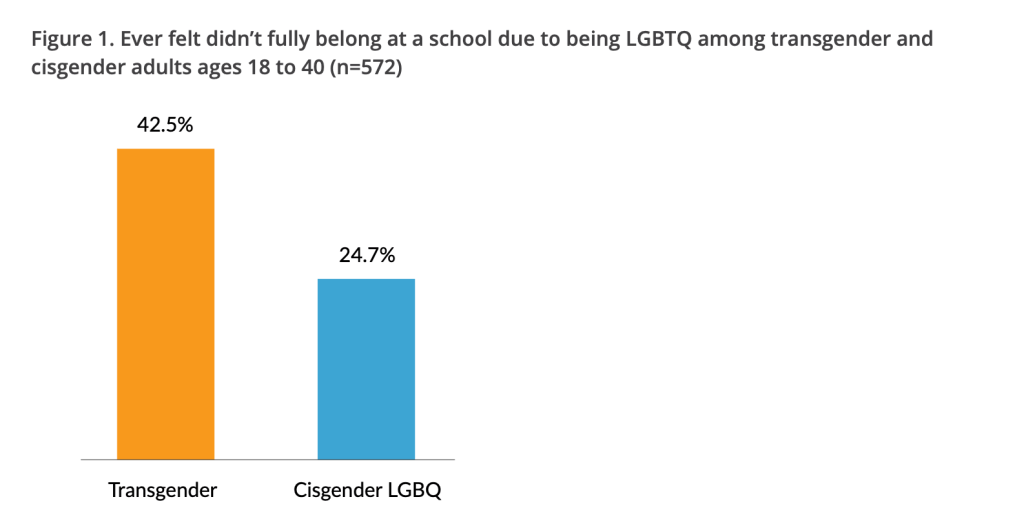
Transgender students are 42.5% more likely to feel like they don’t fully belong than their cisgender counterparts. Additionally, 14.9% reported that they did not feel safe at school across the higher education institutions that they had attended. Why? Support services are severely lacking:
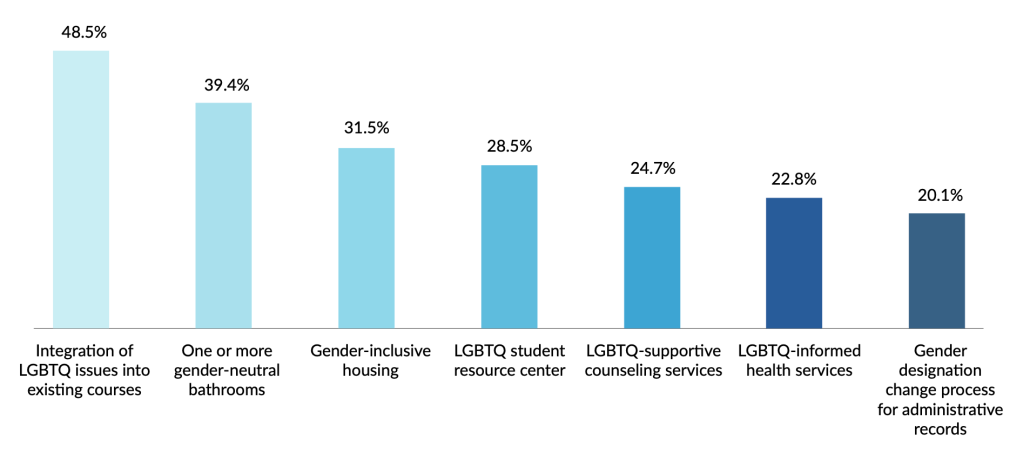
These statistics have SIGNIFICANT impacts of TGNC students’ academic success…
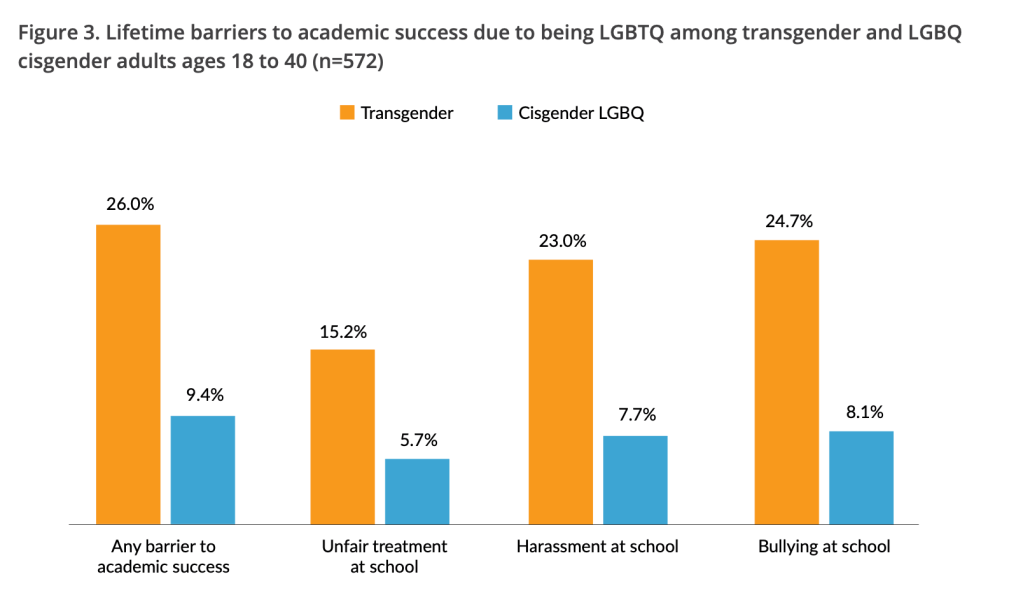
Whereas 11.9% of cisgender non-LGBTQ respondents reported having a graduate degree in the study, only 7.5% of transgender respondents reported this level of academic achievement. SCHOOL IS EXPENSIVE! – But even more so for TGNC students…
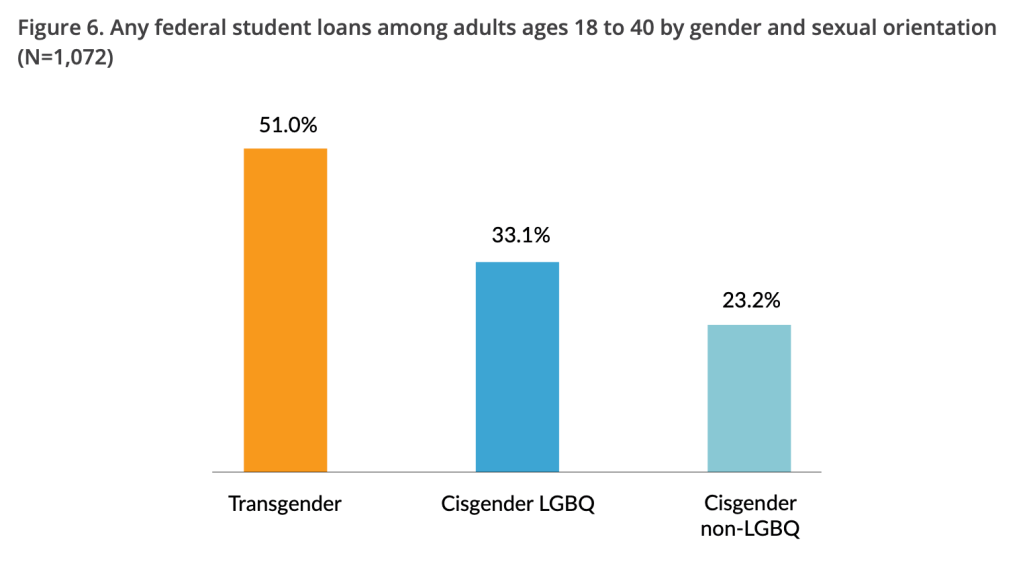
TGNC students are 51% more likely to have student loans PERSONAL ATTESTATION
Every time I complete a project that includes TGNC-specific statistics, I feel both a sense of gratitude and discomfort – discomfort over the fact that so many of those who share my identity encounter significant barriers that impede their potential to be GREAT and gratitude over the fact that I have not encountered the level of harassment and discrimination outlined in these statistics. That’s not to say I haven’t experienced falling in with SOME of the statistics noted above, though, (especially the last one… $6 figures in loans later) — although, I’d probably attribute my place in this statistic to the fact that I have ADHD and couldn’t figure out a fulfilling career track for a while (I finally got it right – 3rd time’s the charm?). This brings me to another point (one more statistic for those who skipped the line of not-so-fun facts above)…
A higher likelihood of expressing gender variance was reported in participants with ASD (7.59%) or ADHD (6.64%) versus those from non-referred comparison groups.
Strong, et al., (2014)So not only are we subject to the challenges that come along with identifying as a minority gender but also those that come along with identifying as neurodivergent. (<– Link provided if you are unsure what that encompasses). Thankfully, my experience in this department has been more positive than dealing with those pertaining to my gender identity.
A SHORT HISTORY OF MY IDENTITY:
A kinda long time ago in the quaint suburban town of Denville, NJ, I was born and assigned the sex of F, therefore I am AFAB (assigned female at birth). Somewhere along the way (in middle school), I realized I was different than my friends who all were boy-crazy and came to the conclusion I liked girls, but didn’t tell anyone for a while because – again – suburban town in the early 00s. I eventually came out as gay in high school and all was good and well until college when I learned there were a lot of other identities out there (I decided to minor in LGBT studies). As my knowledge of diverse identities grew, so did my understanding of my own personal identity, and I began identifying as genderqueer. I came out as transgender in 2016 and started masculinizing HRT (hormone replacement therapy) that same year. The following year, I underwent gender-affirmation surgery and that’s where I am now. As society adopts new lingo every five seconds, I don’t have a static label, but if anyone asks, currently, I identify as non-binary or gender non-conforming (whatever the “kids” are using nowadays). I like they/them pronouns, but nobody really gets those right (including me sometimes), so I accept whatever’s thrown at me as long as it’s not she/her.
HOW MY IDENTITY HAS IMPACTED MY ACADEMIC ACHIEVEMENT
I started college as one identity and have come through another end with a new identity. This, of course, has thrown me some challenges along the way – including a lot of paperwork. The process of changing an official name in the school system was not as easy as I’d hoped. Eventually we figured it out, but it was a long process. As I desired to have my degrees reflect my new name and identity, this was also a long-ish process that required me to present legal paperwork “proving” that I am who I say I am (if I wasn’t, then why would I say I am – Eminem, anyone?). This cost time (AND MONEY!) to get new degrees printed so that I can continue on in my studies with an authentic sense of self (side note: I still don’t have a matching SSN because I gave up with THAT paperwork after two times of being told incorrect information).
Between my first and second graduate degrees, I underwent the brunt of my transition, including surgery, so I’m grateful that I didn’t have to work around that while in school as well. Also during this time, I realized that I felt myself being called to serve the TGNC community, which led me to pursue the professional and academic paths that I am currently on. My choice to pursue a counseling degree was fueled by experiences demonstrating little compassion from professionals for TGNC individuals in the realm of mental health and medicine. I plan to take my experience as a counselor (LAC) with me throughout my journey in medicine (PA-S) so that I am able to educate others in how to communicate empathy, show compassion, and provide competent medical care to individuals with TGNC identities.
Being a graduate student with a TGNC identity means that I am within the ~7.5% of the population with this experience (see above statistic). Therefore, I’ve encountered MANY professors who don’t have a lot of general knowledge about my identity.
I HAVE FEELINGS ABOUT THIS: (and per my girlfriend, this should mean a lot since according to her, I don’t have feelings about many things)
- RESPONSIBILITY: I feel responsible for making sure that the professors I encounter throughout my academic journey are at least as knowledgable about TGNC topics as I am, which often requires that I do more work to “teach the teacher.” This has also caused me to adopt a mindset in every one of my classes of viewing things from a TGNC perspective so that I may pose questions relevant to these individuals and gather pertinent information to utilize going forward in my professional career. During my current program as a Physician Assistant student, I volunteered as a sample patient simply so that my class could see what a trans body looked like because I’m sure that some have never had that experience.
- DISAPPOINTMENT: The realization of my experiences as being so limited in others’ academic journeys is disappointing. Although I am appreciative of how far we have come as a community since my childhood, seeing “a unit” here and there on “trans issues” is not enough to foster competency within the next generation of clinicians. Our experiences and identities should be intertwined within every facet of teaching and taught alongside the experiences of those who identify as cisgender.
- PRIVILEGE: I do feel honored that I am able to influence the teaching and practices of others because of my own knowledge, skills, and abilities. This privilege is the driving force behind my continued academic journey, even though it is tiring at times.
- TOKENISM: I’ve encountered quite a few instances during my counseling degree when professors would glance over at me with a sense of needing approval whenever they would talk about an issue pertinent to the LGBTQ community. Sometimes, I just want to be there to learn! Being THAT STUDENT also has impacts on my relationships with other classmates; I sense that many of them tiptoe around conversations that might be controversial simply because of my identity. Additionally, whenever pronouns are mistaken or identity is incorrectly assumed, people tend to be overly apologetic – which is just awkward for everyone involved – and I feel obligated to appease their mistake rather than give insightful feedback.
Being someone who isn’t afraid to make their voice heard also has put me in a position to feel responsible to influence the changes I see necessary to ensure the safety and comfort of TGNC students on campus. For example, I completed my undergraduate degree at Syracuse University, where they had an LGBT Resource Center and thriving student organization. While the university wasn’t perfect in providing services, at least it had that. When I came to William Paterson, there was no LGBT Resource Center and a failing student organization, so I felt it my responsibility to establish what I could during my short time there – and I did. I became president of the student org, established a private office in the student center so students would feel safe coming there, became the student liaison to the LGBT Advisory Board, and effectively worked with the administration to change all single-user bathroom signage on campus to gender-neutral signage.
Although I am comfortable assuming a role where I take responsibility to elicit change, sometimes it’s hard enough keeping my own head above water. Being a student over the age of 26 also means that I don’t automatically have health insurance, and being a full-time student means that I can’t also work full-time. The university I attend offers health insurance, but this would cut into the funds currently allocated to living expenses and Medicaid is great, but has some SERIOUS flaws – like a 30-day limit on prescriptions (which results in my having to go to the pharmacy every 20 days to refill, which really means about 15 in order to not completely run out), recurrent requirements of prior-authorization that sometimes result in a further need to appeal (which happened this year and resulted in my having to pay for 2 months of my hormones out of pocket), and general customer service misinformation that leads to coverage termination (currently happening). It’s a struggle out here trying to achieve the highest levels of academic success I have set for myself and feeling knocked down by simple things like access to health insurance, but I have hope for the future as well as hope that I will be a part of the future that will bring meaningful and impactful change to the care of TGNC individuals.
This post was written as a requirement of the Transgender First College Scholarship application, which is dedicated to helping underserved Transgender students get affordable access to a college education. #TransgenderFirst
Resources:
Kerith J. Conron, Kathryn K. O’Neill, & Luis A. Vasquez. (2022). Educational Experiences of Transgender People. UCLA School of Law. https://williamsinstitute.law.ucla.edu/wp-content/uploads/Trans-Higher-Ed-Apr-2022.pdf
John F. Strang, Lauren Kenworthy, Aleksandra Dominska, Jennifer Sokoloff, Laura E. Kenealy, Madison Berl, Karin Walsh, Edgardo Menvielle, Graciela Slesaransky-Poe, Kyung-Eun Kim, Caroline Luong-Tran, Haley Meagher, Gregory L. Wallace. Increased Gender Variance in Autism Spectrum Disorders and Attention Deficit Hyperactivity Disorder. Archives of Sexual Behavior, 2014; DOI: 10.1007/s10508-014-0285-3
The TGNC Blog
Where the posts page contains popular items in the news or media, this page will be more about current trends, general research, and opinion pieces regarding the TGNC community.
Find us on: (COMING SOON)
Join the fun!
Stay updated with our latest posts and other TGNC news by joining our network.
 TGNC Health